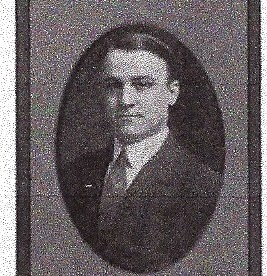
James Casper Negley was my husband's grandfather. He was one of the first people I found in researching the Negley family because he had a biography in the National Cyclopedia of Biography. He was a prominent Los Angeles surgeon.
James was born on 8 August 1883 in Elizabeth, Pennsylvania to John Milton Negley and Margaret Hepler. John was a member of the prominent Negley family of Pittsburgh. However, he was from a poorer branch and was a farmer in Elizabeth. I believe that James was named after his cousin, James Scott Negley, a famous Civil War General and later political figure. I don't see any Jameses in the family until after the Civil War, although there were Jacobs. Likewise no Jameses in the Hepler family(although Jacobs). The Casper was for his great grandfather, Casper Negley. James was the youngest child with two older sisters, Ida Katharine and Elizabeth (Lizzie) Mae. In 1890, when he was 7 his mother died. This must have been traumatic for the family. In the 1900 Census we find John living in Pittsburgh as a streetcar driver and his children living on the farm in Elizabeth. I assume that he was working to earn money and perhaps home with the kids on the weekends. However, whatever happened I believe that James and his father had a falling out. I say this based on the fact that James went straight to Los Angeles when he graduated from College and never went back to Pennsylvania, never took his kids there, probably never talked about it. Thus, his son never told his kids about it either and my husband found out from me that there is a big main street in Pittsburgh called Negley Avenue and that his ancestors were the founders of the city. It may not have been his father he had a falling out with but the other Negley relatives in the area.
Anyway, we find Jim (as he is called in his High School Annual) in 1906 in the New Wilmington High School Annual. It says, "Ever since he cut Prof. Hewie's hair too short "Neg" has lost his "drag' with the faculty. {Best I can interpret this use of drag is standing or PR}. However, he is still as popular as ever with the fellows. Although short in stature, no chicken roost's too high for Jim. He's great on Jui Jitsu, having thrown nearly the whole class of 07 in the Flag rush." Apparently he cut hair to earn his way through High School and College. After graduating High School in 1906 (his father having died in 1908 he put himself through his higher schooling it seems). he went to Westminster College and thence to the University of Michigan where he attained his Medical degree. He also appears in the 1910 University of Michigan Yearbook, the Michiganensian, where the following is said of him, "James Casper Negley is said to have a grand chance for becoming famous. The master tonsorial artist, it is said, was driven into the practice of surgery by the invention of the Safety Razor, but with a technique already mastered for wielding the delicate instrument, his success as a medical man who operates is assured."
His WWI draft card describes him as medium height, medium build, gray eyes and black hair. His WW II draft card describes him as 5' 6" tall, 150 pounds, brown eyes, brown hair. I can see that he could have had very dark brown hair but hard to see why gray and then brown eyes?
James graduated from University of Michigan with his M.D. in 1910. He is recorded in Los Angeles with a Dr.'s license in 1911. He interned at Crocker Street Emergency Hospital 1911-1917 and also was an Asst. District Surgeon for the Southern Pacific Railway in 1914-1917. Around 1913 he advertised for a nurse, Catherine Constance Collins applied and he married her in 1914. He went on to Los Angeles General where he was Jr. Attending Urologist 1920-1925, Senior Attending Urologist 1925-1945 and head of the Dept of Urology from 1940-1945. He wrote several esteemed articles on urology, held posts in medical and urology societies and was very well known and respected in his field.
James and Catherine had two children, James Casper Negley, Jr. and Barbara Jean Negley. Both married and James had two grandsons that he knew and played with, Patrick and Dennis and three others born after he died. Interestingly, his older sister, Ida Katharine, lived with him from before 1935 and continued to live with his wife for 7 years after his death, dying in 1958.
James was a success in his profession, in his marriage and with his patients. This is what one of his fellow doctors says about him in his memorial: "Jim as he was known to his multitude of friends will be sorely missed. His dry wit, his love of fair play, his humorous contempt for stuffed shirts and big shots, his deep affection for family and friends, his love for dogs and the great outdoors, his love of medecine and the specialty of urology endeared him to all who really knew him. The grief of the many old patients who came to pay their last respects to Doctor Jim was heartfelt. He had restored their health and given back life--and of many he had asked nothing in return." E.T Remmen, M.D.
Uncle Dave's book
Friday, April 24, 2015
Saturday, April 18, 2015
52 Ancestors Year 2 #17: Rev Stephen Bachiler, Puritan Minister and nonconformist
Rev. Stephen Bachiler lived a long and rather cantankerous life, I just found him while looking for an ancestor to answer "live long" in the challenge. Born on 23 Jun 1561 in Wherwell, Hampshire, England to Philip Bachiler and Anne Flanders, he graduated from St. John's College at Oxford University in February 1586. He was given a position as Vicar in Wherwell by Lord De La Ware (the father of the one for whom the state of Delaware was named). He was there until 1605 when he was ejected for his Non Conformist beliefs. In 1593 a law had been passed against the Puritans making the practice of their religion illegal. There are mentions of Stephen still preaching in various places and in one he is called "a notorious non conformist".
Stephen was for the separation of Church and State and was considered "a liberal Puritan, zealous of human rights." He joined a group of dissenters who formed the "Plough Company" which obtained a grant for a piece of land in Maine. On 9 Mar 1632, he set out for America aboard the ship "William and Francis". He took his third wife, Helen, his daughter, Deborah and her children, and three sons of his daughter Ann with him. It was a rough crossing which took 88 days. At this time Stephen was 71 years old! One of the things he brought with him was his personal oak chair. This chair can be seen today in the Metropolitan Museum of New York.
Once arrived Stephen began preaching at a church in Saugus (now Lynn).Massachusetts. Before he had been preaching for four months he came under "suspicion" of having "independent ideas" which he was not willing to yield to the dictates of others. For awhile he was not allowed to preach to anyone that he had not brought with him. This was removed and he preached at a number of towns in Massachusetts. In 1638 he received a grant of land and started a settlement at what is now Hampton, New Hampshire. He founded a Church there which is now the oldest Congregational Society in New Hampshire and the second oldest continuous church fellowship in the U.S.
At one point during his stay in Hampton, his house burned down. The biggest loss was his library--worth 200 pounds! He had other problems there, though. He had differences with his parishioners and in 1644 he was excommunicated! In 1647 he moved to Portsmouth, New Hampshire, where at the age of 80 he "solicited the chastity of his neighbor's wife" according to Governor John Winthrop. His wife had died and at the age of 86 he married a young widow, 60 years his junior. She then had an affair with their neighbor, George Rogers, with whom she had a child. They were both sentenced to be flogged and she to be branded with the letter "A". It has been speculated that Hawthorne based the character of Hester Prynne in "The Scarlet Letter" after her. The court refused to allow Stephen and Mary to get a divorce insisting they live together as man and wife. At this pint Stephen had had enough and went back to England where he died and was buried in London on 31 Oct 1656.
Stephen was a man of rare physical and intellectual vigor. John Winthrop classed him among "honest men." Rev Cotton wrote of him, "I find he was a gentleman of learning and ingenuity." Joseph Dow in The History of Hampton, N.H." describes him as "...obstinate and tenacious of his opinions to a marked degree, a powerful preacher drawing largely from scripture, impress the hearers with the uncommon power and sanctity of his sermons, strong in his friendships and in his hates." He incurred the hate of the Massachusetts Ministers by casting the only dissenting vote to the expulsion of Roger Williams (a noted exponent of religious toleration and for fair dealings with the Native Americans). His descendants include James Dean, Winston Churchill, Daniel Webster, Richard Nixon, and Gerald Ford. Daniel Webster considered that his abilities were inherited from Stephen Bachiler. In The Great Migration Begins, Robert Charles Anderson says, "Among the many remarkable lives lived by early New Englanders, Bachiler's is the most remarkable."
Friday, April 10, 2015
52 Ancestors Year 2 #16: James Bartlett Hudson
James Bartlett Hudson was the son of Benjamin Lester Hudson and his second wife, after the death of his first wife, Mary Yuiel. I don't know much about him but I am writing this because it shows the importance of finding someone in all Censuses and looking at all possible records. Last week I wrote a blog about Benjamin Lester and I said his second wife was Mary Roberts and they had a son, Bartlett Hudson. After I wrote my blog I noticed a leaf on Ancestry for Bartlett Hudson. t was his marriage certificate in 1925 which gave his parents as Benjamin Lester Hudson and Mary Halliot. I also found a marriage record for Benjamin Lester and Elizabeth Roberts for 1890. In the 1900 Census we find Benjamin , Elizabeth and Bartlett Hudson. I had assumed the family data, that he had married Mary Roberts, just was in error as to her first name. But it appears that the family data had combined the names of the two women and come with Mary Roberts. I have never found Benjamin in the 1880 Census. His children by Mary Yuiel are either living in a logging camp or with his sister. Now I find Mary Hudson and James B. Hudson living in Coshocton, Ohio in 1880. She is listed as married, no sign of Ben. She must have died before 1890 when he married Elizabeth Roberts. Looking further we discover the divorce record of Ben and Elizabeth in 1905. He filed, the pending record says for desertion but the final decree ways "Extreme Cruelty". I can only conclude that the death of his wife, Mary Yuiel, was very unsettling to Ben. He farms out his children, remarries but to some degree deserts her. Second wife dies, he takes their son but remarries. Then he divorces wife #3. I know that my Great Grandfather, Benjamin Melvin Hudson, was estranged from his father because he felt abandoned after his mother died. They did eventually reconcile. I haven't been able to find any more on the two wives or James Bartlett. But it shows what you could miss if you don't look at every possible record!
I should note what I do know about James Bartlett Hudson. He was born in July 1878 according to the 1900 US Census. (According to his marriage license he was born 22 Aug 1875.). He married Louise Schwalen nee Kolb (or got the license) on 29 May 1925 in Toole County , Montana. They were living in Sweetgrass, Montana at the time. The pictures here are of Sweetgrass. I haven't found him later than this. I did find a Louise Hudson living in Los Angeles as a widow in the 1930 Census.
Saturday, April 4, 2015
52 Ancestors Year 2 #15: Benjamin Lester Hudson and a Favorite Photograph
Benjamin Lester Hudson was my 2nd Great Grandfather, born 13 Apr 1828 in Huntingdon, Quebec, Canada and baptized in Iberville, Quebec. His parents were Robert Brick Hudson and Anna Mariah Delamater. Benjamin was the name of Robert's older brother who died as a soldier in the Revolutionary War and of Robert's mother's Grandfather, Benjamin Gott. Lester was his maternal grandmother's maiden name. Benjamin was the eighth child and sixth son of Robert and Anna Mariah. By 1851 the family had moved to Bristol, Ottawa County, Quebec, Canada. This town is right on the Ottawa River and Robert was involved in moving lumber down the river to sell in Ottawa and Hull.
On 5 Nov 1854, at the age of 26, Benjamin married Mary Yuiel who was born in Scotland and came to Bristol with her family. He is listed as a farmer in the 1861 Census of Bristol. In 1865 his mother died. This was a turning point for the family as in 1866 he and is family, his father, his sister, Elizabeth and her family and another three brothers moved back to the U.S., primarily to Saginaw, Michigan. At the time of the move, Benjamin had five sons and one daughter. Another son, Archibald, was born in Saginaw in 1878 and a daughter, Mary Jane, in 1870. On Dec 28, 1874, Mary died at age 35 in "Confinement", or in childbirth. This left Ben with 8 children under the age of 19, the youngest not quite 4. Right after this in March 1875, George Edward, his oldest child, died. One can imagine how distraught he must have been. To cope with this he sent several of his children to live elsewhere. In the 1880 Census of Saginaw you find his three oldest sons, Alfred, Robert and Benjamin, are living as raftsmen in a logging camp, his youngest son and daughter are living with his sister, Elizabeth and her family. I haven't found Benjamin Lester in the 1880 Census.
We find him in 1900 living with his second wife, Elizabeth, and their son, Bartlet. In 1910 he is widowed, living with his son, Robert. On 15 Mar 1917, Benjamin died as a result of "shock following accident". According to his obituary he fell down a flight of stairs and broke his collar bone. The obituary calls him a "farmer and lumber jobber".
In about 2009, I had just picked back up the family genealogy from where I'd left it when my children were born in the early 80's. I started to work on Ancestry and when I searched Benjamin Lester Hudson I found a picture of him with four generations: his son, Robert Brick, grandson, Edward Wesley, and great grandson, Edwin Hudson. Edwin was born in 1909 so the photo is approximately 1910. On the back of the photo is written this data and the fact that Benjamin Lester is the son of Robert Brick Hudson, brother of "Grandfather Charles Hudson". I sent a message to the person who had put the photo on Ancestry. This was written by Samuel Lorenzo Hudson, grandson of Charles and therefore a cousin of Benjamin Lester Hudson. The woman who posted the photo and her mother decided to send me the photo as I was a direct descendant of Benjamin. I was so blown out! I later found out that Samuel Lorenzo Hudson was a well known Genealogist in his time. It is fascinating to me to see how the family members kept track of each other over the years. The back of the photo also gave me fascinating data about Benjamin's father, Robert Brick Hudson
.
Sunday, March 29, 2015
52 Ancestors Year 2 #14: Sancha de Ayala, Spanish Noblewoman
Sancha de Ayala brought the only non-Caucasian blood into the family tree that I have found! Some twenty-one generations before her a Spanish ancestress married one of the Caliphs of Cordoba, an Arab of the Umayyad Dynasty. An account of her and her family tree on Rootsweb said that this made her a descendant of Mohammad. However, I studied this out and the Umayyads were not descended from him. They were cousins. But she is interesting for much more than this!
Sancha was born in 1360 in Toledo, Castille, Spain. Her father, Diego Gomez de Toledo, was a nobleman who lived in a palace. His grandfather was the Grand Chamberlain of King Fernando IV. Her mother, Inez Alfonsa DeAyala, was of an old noble line which included many kings, and went back to the house of Lara from which all the Kings of Spain come. So she and all her siblings took her mother's name. Perhaps of most interest to us is the fact that her 12 times great grandfather on her mother's side is Rodrigo Diaz de Vivar or El Cid, the great Spanish Conqueror and hero. He is my twenty-ninth great grandfather. Sancha's brother, Pedro Suarez DeAyala, became the great grandfather of Ferdinand I of Ferdinand and Isabella fame and is the ancestor of almost of the kings and queens of Europe including Queen Elizabeth II of England. So she is well connected!
In 1371, Constanza, daughter of the deposed king of Castille, Don Pedro(the Cruel) I, came to England and married John of Gaunt, son of Edward III. She brought several young Spanish noble ladies with her, including Sancha. In 1373, Sancha married a Knight in the employ of John of Gaunt, Walter Blount. She was friends with Geoffrey Chaucer, author of The Canterbury Tales, and his wife, Philippa. There are various references to the Blounts in the contemporary records. Sancha and Walter had two children, Thomas and Constance. Walter was killed in the battle of Shrewsbury on 21 July 1403. He is mentioned in Shakespeare's Henry IV. Sancha founded a chantry in the Hospital of St. Leonard in Derbyshire after her husband died and helped her daughter raise her children after her husband died. Sancha made her will in 1415 (it still exists!) and died in 1418. She was buried beside her husband in the Collegiate Church of St. Mary in Newark, Leicestershire. She seems like a model noblewoman of the period.
Both her son, Thomas and her daughter, Constance, had children some of whose descendants came to America. Presidents Benjamin Harrison and William Henry Harrison, and the two Bushes are among them. I think it is fascinating how one woman doing such a simple natural thing as marrying and having children can have such influence!
Friday, March 20, 2015
52 Ancestors Year 2, #12 Maria Teresa Rosa Tinetti and #13 Maria Teresa Domenica "Minnie" Tinetti, twin sisters
Maria Teresa Rosa Tinetti and Maria Teresa Domenica (Rosa and Minnie) Tinetti were born on 15 Oct 1868 in Vallia, a frazione of Torre Canavese, Piemonte, Italia. They were the second and third child and first daughters of Giovanni Tinetti and his second wife, Catterina Zanotti-Cussio. Domenica was born first. On 16 Aug 1885, Rosa married Luigi Bonino. Rosa was only 16. Luigi had been in America and returned to Italy to find a wife. After marrying Rosa the two of them returned to America. They went to Hurley, Wisconsin, where they ran a Saloon for the miners there, many of whom were Italian. Rosa soon sent for her twin sister, Minnie, who arrived in 1888. Shortly after arriving, Minnie married Pietro Giovanni Peretti who came from Priacco, a town not far from Torre Canavese. A year or so later Rosa sent for their younger sister, Angelina, who married in 1891 a miner from Sporminore in Trentino, Italy. Soon Rosa and Luigi (now Louis) moved to Coal City, Illinois, where Minnie and Pietro lived and Angelina and Frank moved to Comox, Birtish Columbia, Canada. Eventually Rosa and Louis moved to Coalgate, Coal County, Oklahoma where they are both buried. The three sisters stayed in touch, I have photos in my family collection of their children visiting each other. Rosa and Luigi had 7 children as did Angelina and Frank Stefani, while Minnie and Pietro had 11 children. Luigi died in 1920, Pietro in 1926 while Rosa lived to 1942, Minnie to 1946. Angelina died in 1947 having outlived all her siblings while Frank survived them all not dying until 1953.
Neither Rosa not Minnie had twins but Angelina's daughter, Edith, had twins (my mother, Margaret and her brother, Milton). I was told it was passed in the female line and skipped a generation which put me in line for twins but I didn't have them. I think it interesting that the photos I have of Rosa and Minnie in their later years look quite a bit alike, you can see they are twins! Rosa seems to have been the trend setter in the family, being the first to get married, first to come to America and bringing her sisters after her. She was the first to have a child, and the first to lose a husband. I suspect the family looked to her for leadership and advice for her whole life!
Friday, March 13, 2015
52 Ancestors Year 2 #11: Michael James Collins, Irish farmer of Leatra
Michael James Collins was my husband's grandmother's father. He lived in Galway, in the Province of Connaught in the western part of Ireland. He lived in the townland of Leatra, which name, "Liath thra", means grey sand. This area is on a well travelled route from Western Ireland to the East used by wayfarers and armies throughout the ages. A major battle was fought there in 1316, contesting the kingship of Connaught.
Michael was born around 1855, married Mary Connally around 1878. I have not found exact records for ether event. I did find the baptismal record for their first child, Mary, born 14 Nov 1878 in Leatra. They had ten children, 6 girls and four boys. We find the family in the 1901 and 1911 Irish Census. In 1901 their house is described as having stone, brick or cement walls, one room and one window. They are Catholic, speak Irish and English and neither Michael nor Mary can read or write. In 1911, the Census reports that Michael is blind(it didn't say this in 1901).
Michael seems to have been a bit of a fighter, he stood up for his rights. Eileen Finnegan in "A History of the Parish of Templetogher and the Town of Williamstown", she describes the "Springtown Riots." These took place in 1880 at the end of a three year famine. The tenants requested a reduction of rent and were not given it and they rioted. Police were present but refused to fire on the crowd so injuries were minor being confined to three people with bayonet wounds, one of whom was "a Collins man from Leitra". I believe that this was Michael, could have been a brother but the only Collins man seen with the designation of Leitra(Leatra) at that time is Michael. I've also found a number mentions of him in the Petty Court Sessions records from Williamstown either as a complainant or defendant. As a complainant it has been about people trespassing or owing him money. As a defendant it has been because he refused to pay a particular assessment, and he was allowed to not pay it! He also was accused of having an unlicensed dog. I also find him in the Dog License records up to 1914 licensing Female or Male Curs almost all yellow, one brown. I guess he learned his lesson on the dog licensing.
The one other record or notice I've found of him is the fact that in 1886 he gave some of his land for the use of founding a National School in Leatra. He swapped the land for another field, but still he made it possible for his children and the others in the area to receive an education. I think he probably realized that his own lack of education (he couldn't read or write remember) kept him from being more that a poor farmer and wanted something better for his children. And most of them did go on to other places and better lives. His son, Patrick stayed on the farm and it is still in the family today.
I don't have a record of his death or know when it was. He was buried in Cill Croain (Kilcroan) Cemetery near Ballymoe. There is no headstone. His wife, Mary, is buried in Kildarea Cemetery near Polredmond. Again, no headstone. There many descendants in Ireland, England and the U.S. still remember or visit Leatra when they can.
Subscribe to:
Posts (Atom)


%2BBonino.jpg)